Press Release

The nation’s founding was shaped not only by lawyers, soldiers, and statesmen, but also by retailers, importers, exporters, financiers, and commercial leaders.
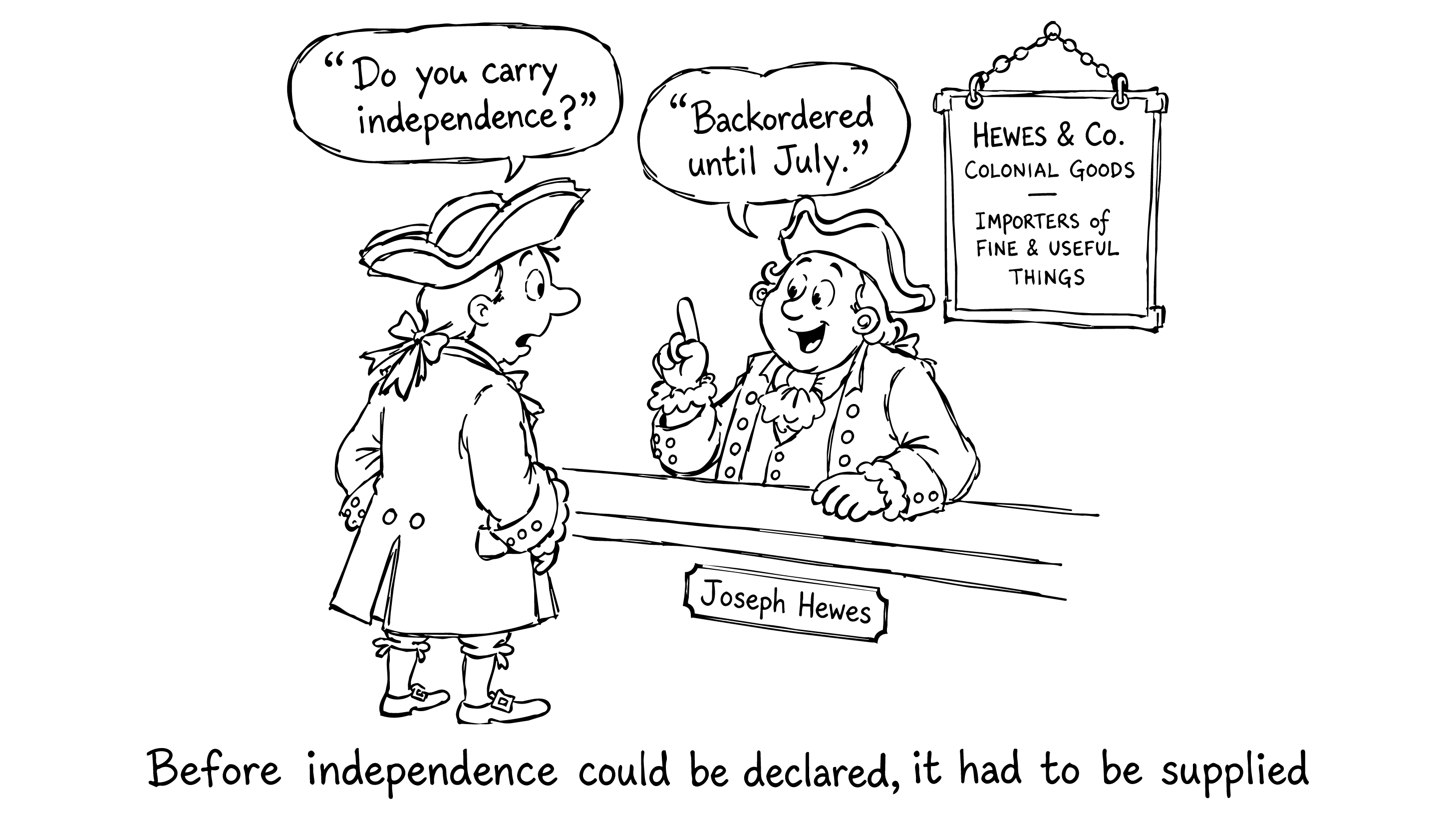
On February 14, 1776, months before the Declaration of Independence was signed, Joseph Hewes put a merchant’s tool to work for the coming revolution: a contract.
Hewes, a North Carolina delegate to the Continental Congress and a merchant from Edenton, agreed to hire out the brigantine Fanny for service to the “United American Colonies.” The ship was to carry tobacco and other Virginia produce to Europe, then return to North America with “Goods, Wares, Merchandize arms, & ammunition.” The agreement covered the practical details of commerce: cargo, port charges, insurance, freight, risk, and delivery. It was not a battlefield order or a soaring speech. It was a supply-chain document.
Before independence could be declared, it had to be supplied.
That was a world Joseph Hewes understood well. Before he became one of North Carolina’s signers of the Declaration of Independence, he had built a commercial life that would look strikingly familiar to anyone who understands the many moving parts behind modern retail. Born in New Jersey to Quaker parents, Hewes chose commerce over farming, moved to Philadelphia to apprentice in an import business, and later settled in Edenton, North Carolina, a prospering port town. There, with business partner Robert Smith, he owned a store on Main Street, offices, three warehouses, a wharf, and five ships. And he opened a ship-repair and shipbuilding yard and a factory for braiding rope.
In other words, Hewes’s work stretched from the shop counter to the waterfront. He was sourcing goods, moving inventory, managing facilities, extending commercial relationships, and navigating uncertainty.
As America marks 250 years, it is worth remembering that the nation’s founding was shaped not only by lawyers, soldiers, and statesmen, but also by merchants, shopkeepers, importers, exporters, financiers, and commercial leaders — people whose work touched many of the functions we now associate with retail. Many of the men who signed the Declaration of Independence were merchants, the second most common profession among the signers after lawyers. Some ran stores; others imported goods, owned ships, extended credit, financed supplies, managed warehouses, or built the commercial networks that helped sustain colonial resistance.
By a count of the National Archives’ occupational listings, 17 of the 56 signers were identified as merchants in some form, second only to lawyers for the occupation of those who signed that critical document in 1776.
That term — merchant — covered a broader set of activities in the 18th century than any single modern job title. A merchant might operate a store, import goods, own ships, finance trade, manage warehouses, keep ledgers, extend credit, barter for payment, or connect local customers to global markets. That commercial world was central to colonial life. It was also central to colonial protest.
America’s founding was not carried out by one profession, one region, or one kind of leader. It was built through law and politics, yes, but also through enterprise, trade, risk, supply, and service to communities.
In Boston, John Hancock’s business became a political flashpoint years before he placed the most famous signature on the Declaration of Independence. Hancock had inherited his uncle Thomas Hancock’s lucrative business and became one of Boston’s most prominent merchants. As Parliament imposed new taxes, Hancock’s commercial interests and political convictions increasingly overlapped. He participated in boycotts tied to the Stamp Act and Townshend Acts, and in 1768 British customs officials seized one of his sloops, the Liberty. Officials accused Hancock of smuggling; after a highly publicized trial, the charges were dropped without explanation, likely because of a lack of evidence.
The Liberty episode is a reminder that the road to revolution did not run only through legislative halls. It also ran through wharves, docks, cargo holds, customs houses, warehouses, and shops. Disputes over taxation, representation, and political power were often disputes over goods: who could import them, who could tax them, who could sell them, who could buy them, and who could control the terms of trade.
The marketplace was not separate from the founding story. It was one of the places where that story unfolded.
When Congress needed ships, supplies, accounting, contracts, cargoes, and trusted commercial judgment, Hewes’s experience mattered. The Constitution Center notes that Hewes accepted the chairmanship of the committee responsible for fitting out the first American warships. That role drew directly on the skills of a merchant who understood vessels, costs, materials, timing, suppliers, and risk.
And the broader community of merchants, shopkeepers, tradespeople, and consumers helped turn abstract arguments about rights into daily choices. That is the connection worth remembering during America’s 250th anniversary. The founding generation did not have retail in the way we understand it today. They did not have national store networks, e-commerce platforms, modern logistics systems, digital payments, or global supply chains measured in seconds. But they did have stores, warehouses, ships, ledgers, credit, customer relationships, imported goods, and the hard practical work of getting people what they needed.
They also had the civic responsibility that comes with commerce.
Before Philip Livingston signed the Declaration of Independence, built a career in the import business in New York City. His store sold a striking range of imported goods — black pepper, Bohea tea, Jamaica rum, cheese, iron pots, hardware, glass, marble chimney pieces, and furs. He later represented New York in the Continental Congress and signed the Declaration of Independence.
Signers Robert Morris and George Clymer both turned commercial skill into revolutionary capacity. Morris, a Philadelphia merchant who rose through a shipping and banking firm, became one of the wealthiest men in America and was later known as the “financier of the Revolution.” He served on the Secret Committee of Trade, helped procure arms and ammunition, and became Superintendent of Finance. Clymer, also of Pennsylvania, moved from clerk to partner in a mercantile firm and was drawn toward independence in part by the impact of British economic restrictions on his business.
America’s founding was not carried out by one profession, one region, or one kind of leader. It was built through law and politics, yes, but also through enterprise, trade, risk, supply, and service to communities.
From Joseph Hewes’s Main Street store in Edenton to his contract to help move goods, arms, and ammunition for the revolutionary cause; from John Hancock’s Boston sloop to the consumer boycotts that turned buying decisions into political acts, commerce was woven into the fabric of independence.
As the nation looks back on 250 years, retailers can see part of their own story in that history. The work of retail has changed dramatically. Its tools, scale, technology, and reach would be unrecognizable to the merchants of the founding era. But the essential work—connecting people with goods, supporting communities, managing risk, building trust, and keeping commerce moving through uncertain times — has been part of the American story from the beginning.