Press Release

Inflation drives higher credit card swipe fees, raising costs for retailers and consumers. The Credit Card Competition Act offers a bipartisan fix.
Americans are feeling the squeeze from higher energy prices everywhere from the gas pump to the grocery aisle. But there is one beneficiary of rising prices that most consumers never see: the banks collecting percentage-based swipe fees every time a credit card is used.
Consider what happened at the gas pump this year.
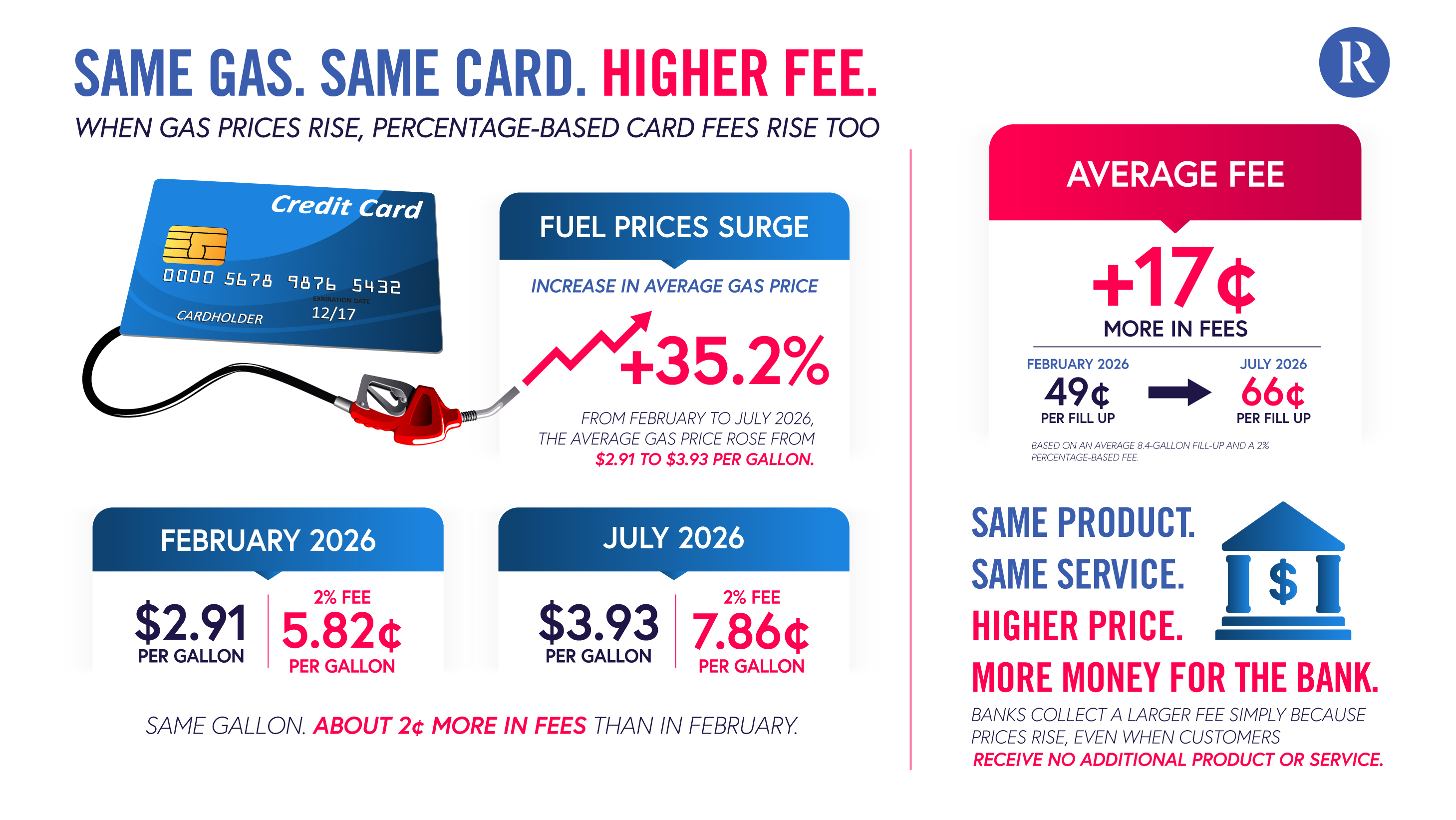
In February, the average price of regular gasoline was $2.91 per gallon. By July, prices at the pump climbed to $3.93 — a 35% increase.
For a driver buying 10 gallons, that's the difference between paying $29.08 and $39.32.
The driver isn't buying more gasoline. The gas station isn't selling more gasoline. But because credit card swipe fees are largely calculated as a percentage of the transaction, bank fees went up to squeeze station and the driver even harder.
Credit card fees vary, but many fall around 2% of the price of swipe, so the swipe fee on that 10-gallon purchase would rise from about 58 cents in February to 79 cents in July. Now consider that Americans buy 11.5 billion gallons of gasoline a month, and much of that is bought with a credit card.
That is the hidden inflation multiplier built into America's credit card system. But the effect doesn't end at the pump.
Higher energy prices increase the cost of moving products. Trucks have to deliver food and merchandise. Distribution centers need energy to operate. Retailers have to move products from ports and warehouses to store shelves and consumers' doorsteps.
Then, when those costs contribute to a higher shelf price, the swipe fee grows too.
Retailers and distributors are paying more to get the product to you. Banks get a larger profit because the dollar value of the transaction went up.
Those fees can add up.
Using February's gasoline price as a baseline, EIA gasoline consumption data, NACS's 29% credit-card share at the pump and a general 2% percentage-based fee, we estimate that higher gasoline prices generated approximately $375 million in additional credit-card fees from March through July alone. The estimate measures only the additional fee associated with prices above February levels—not the total swipe fees collected on gasoline during that period.
And that's just gasoline. Multiply the impact across the average family’s budget: Gas, groceries, restaurants, clothes—anywhere a credit card is swiped—and the fees on the average family’s purchases really stacks up.
Swipe fees aren't simply a retailer problem. They are a cost of doing business, and like transportation, rent, utilities and other operating expenses, they ultimately factor into the prices consumers pay.
The Government Accountability Office has previously noted that rising card-acceptance costs can result in higher prices that affect even consumers who don't use credit cards.
The problem is compounded by a payments marketplace with too little competition.
Today, when a consumer pulls out most Visa or Mastercard credit cards, the merchant generally does not get to choose among competing networks to process that transaction.
In virtually every other part of retail, businesses can shop around.
Retailers compete fiercely for consumers. They negotiate with suppliers. They compare shipping companies. They choose technology providers. Competition puts pressure on businesses to lower costs, improve service and innovate. Retailers do everything they possible can to try to lower costs.
Credit card processing should not be different.
The Credit Card Competition Act of 2026 would finally introduce meaningful competition into this market.
The bipartisan legislation, introduced in the Senate by Senators Roger Marshall, Dick Durbin and Peter Welch, would require credit cards issued by banks with more than $100 billion in assets to be enabled on competing, unaffiliated payment networks. It would also prohibit restrictions that prevent merchants from choosing among the eligible networks available to process a transaction.
Importantly, the CCCA does not impose a government-set cap on credit card swipe fees.
It relies on competition.
Giving merchants a choice of networks gives those networks a reason to compete for transactions based on price, security, service and innovation, exactly the market forces that drive better outcomes for consumers.
Consumers don't see a line on their receipt that says "swipe fee."
But they pay for a system in which those fees are embedded in the cost of accepting electronic payments — and where fees climb automatically when inflation pushes prices higher.
That's particularly hard to justify at a moment when families are already stretching household budgets to cover gasoline, groceries and other necessities.
A consumer who buys the same 10 gallons of gas shouldn't trigger a dramatically larger fee. And retailers shouldn't be locked into a payments system where the dominant networks face little pressure to compete for their business.
Competition is at the heart of the American economy. It drives innovation, disciplines costs and gives consumers better prices, products and services.
Congress should pass the Credit Card Competition Act and give retailers the ability to choose among competing networks.
At a time when consumers are being squeezed by higher prices, Washington should be looking for ways to introduce more competition and take unnecessary costs out of the system—not allow inflation to become an automatic revenue escalator for the largest credit card companies and Wall Street banks.