Blog Post

A smarter approach to retail crime is coming to the RILA Retail Asset Protection Conference and the data behind it will change how you think about where to focus.
Moderated by Jon Briegel, Director of Solutions Engineering at Auror and former Executive Team Leader AP across multiple stores at Target.
You’ve likely heard of the Pareto Principle, also referred to as the 80/20 rule, stating that roughly 80% of outcomes come from 20% of inputs. That uneven distribution is even more extreme in retail crime.
Since pioneering Retail Crime Intelligence a decade ago, Auror has measured the portion of harm caused by top retail offenders, for both retail partners and regions. Over the years, we’ve seen the same consistent pattern: the top 10% of offenders account for 60 to 70% of overall value and are up to 4X more likely to be violent. In North America, the top 10% are responsible for 70% of stolen value.
“Your top 10% of retail offenders are responsible for 70% of stolen value.”
Even before their first conversations with us, asset protection leaders sense this. The same people of interest show up in incident reports. The same patterns repeat across stores, retailers, and jurisdictions. But sensing it and being able to act on it are very different things. And for most retailers, the gap between the two is wider than it should be. The reason is not a lack of data, but lack of connection.
There’s no shortage of retail crime data. Stores file incident reports; asset protection (AP) teams build cases; law enforcement receives referrals. But in most organizations, that data sits, isolated by store, region, tech system, and banner. An offender who hits five locations across two markets doesn’t appear as a prolific offender in typical reporting. They appear as five separate persons of interest across five separate cases. That fragmented data has a direct cost.
When you can’t see the pattern, you can’t prioritize around it. Resources get spread evenly across the full volume of incidents rather than concentrated on the small group of people driving the majority of harm. The 10% stay invisible. And because they know they’re invisible, they keep coming back.
Auror's Retail Crime Intelligence platform processes millions of retail crime events across North America alone. The patterns that emerge from that data are remarkably consistent.
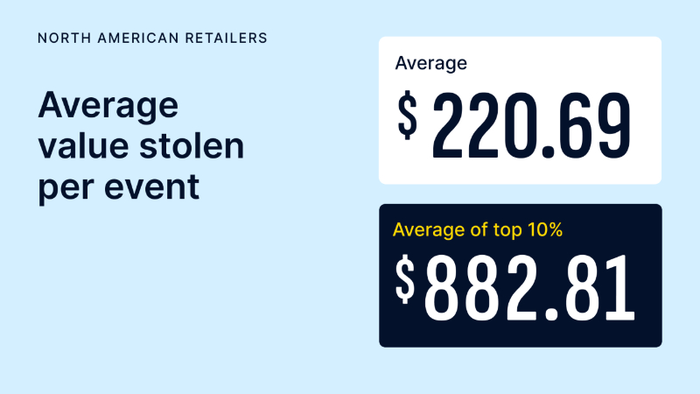
In 2025, the average event value was $220.69, nearly five times the median due to the outsized impact of top offenders. And for the top 10% of offenders? $882.81 per event, 4X the average value.
These are not opportunistic shoplifters. They are professionals operating at scale. And they’re responsible for more than lopsided losses. They're also more likely to cause harm.
Events involving repeat people are 2.5X more likely to involve a weapon in North America. And at retailers where this data has been analyzed in depth, repeat people are up to 4X more likely to be violent than first-time offenders.

This is both a loss and safety problem. And it’s concentrated in a fraction of your offender population.
Globally, Auror has now connected more than one million dots, linking incidents across stores to surface the patterns that fragmented reporting misses. Once the 10% become visible, retailers find that the case for focusing on them is overwhelming.
At one major retailer, connected intelligence revealed that repeat people drive 62% of total loss, and two out of three of those repeat people are hitting multiple store locations. What looked like hundreds of separate incidents was, in many cases, a small number of individuals operating systematically across a network of stores.
Thankfully, the data also shows what happens when you intervene. In the case of the major retailer above, half of repeat offenders did not return after a successful intervention. That’s more than an asset protection outcome, it’s a deterrence signal. When prolific offenders know they are visible and likely to be caught, the calculus of returning changes.
What law enforcement can do with connected intelligence
The law enforcement side of this equation plays a critical part in stopping prolific offenders.
One of the most common frustrations for AP teams is the sense that retail crime referrals disappear into a void. Cases get filed but nobody follows up. As a result, the same offenders keep appearing. That’s because a single incident report is difficult to act on and even more difficult to justify doing so. Retail Crime Intelligence provider Auror helps AP teams build a pattern-based case file with cross-store history, behavior data, and supporting evidence to build a much stronger case for law enforcement to progress.
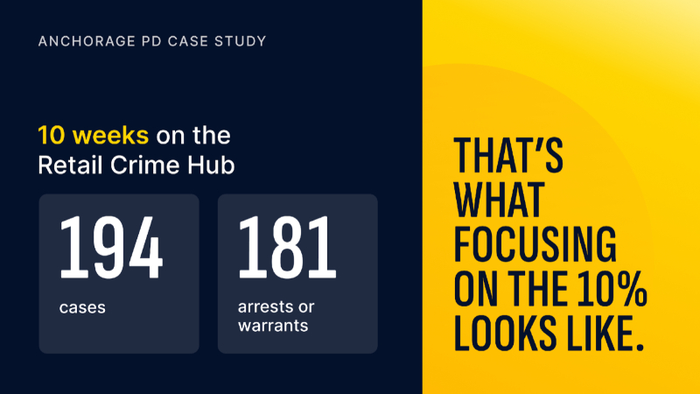
Anchorage PD proved this. After just 10 weeks on the Retail Crime Hub, a product designed for law enforcement teams, and building a dedicated retail crime unit, the department assembled target lists of their top 20 offenders by dollar value and top 20 by number of incidents.
Within roughly 10 weeks, they had investigated 194 cases and driven 181 arrests or warrants. The crimes were the same. What changed was the intelligence behind them: prosecutable cases instead of incident reports, and an approach built for focused action rather than volume.
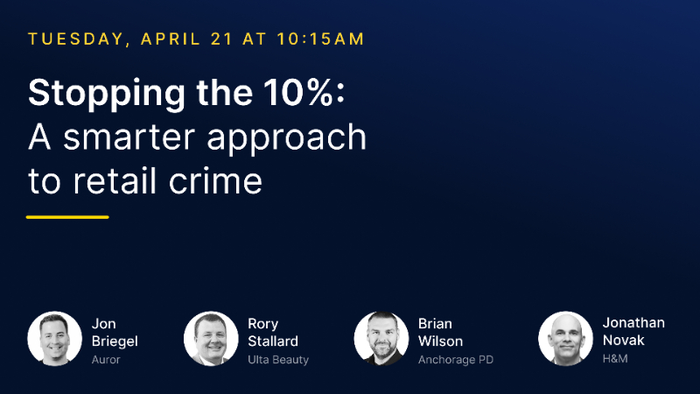
On Tuesday, April 21 at the RILA Retail Asset Protection Conference, a panel of leading practitioners will go deeper on this data and its implications for asset protection and law enforcement with an honest, practical account of what it actually takes to stop the offenders causing the most harm in stores.
The session, Stopping the 10%: A smarter approach to retail crime, brings together:
Moderated by Jon Briegel, Director of Solutions Engineering at Auror.
Whether you attend the session or not, these are the three ideas worth acting on:
The session Stopping the 10%: A smarter approach to retail crime takes place on Tuesday, April 21, from 10:15–11:00 AM at the RILA Retail Asset Protection Conference in Phoenix, AZ. Check the full conference schedule to learn more.
Auror is the Retail Crime Intelligence platform that turns fragmented incident data into prevention, connecting 85,000 stores and 3,500+ law enforcement agencies to reveal the patterns that matter most to stop retail crime. See them at Booth #911 at the 2026 RILA Retail Asset Protection Conference. Learn more at auror.co/rila.
This is a sponsored post by RILA's Retail Asset Protection Conference Title Sponsor Auror.