



Press Release

Rising political uncertainty, Iran tensions, and U.S. policy divisions are shaping retail operations, consumer sentiment, and economic outlook.
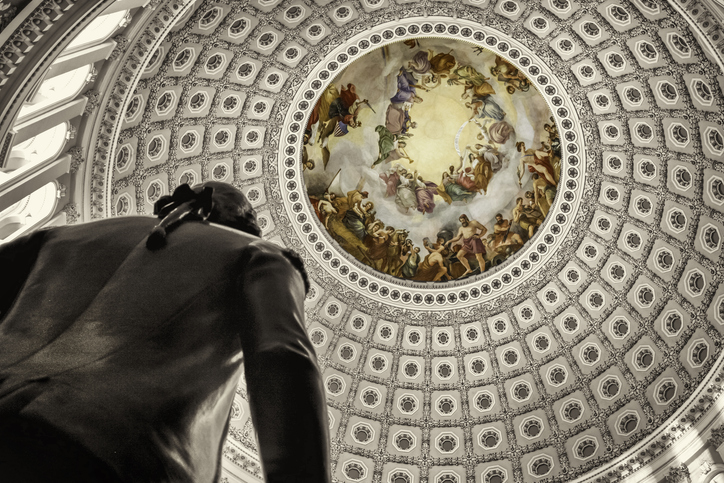
Political uncertainty remains elevated at the federal, state, and international levels, creating a challenging environment for policymakers, businesses, and consumers alike. This week the House and Senate will continue the April work period, faced with questions about Iran, DHS and national security legislation. Abroad, peace talks to end the Iran war remain fragile, and long-standing U.S. allies continue to reassess their strategic alignments, adding to global economic and geopolitical uncertainty.
Domestically, divisions within the Republican party complicate progress on several critical issues, including federal funding, national security authorities, and broader fiscal priorities such as new reconciliation bills. These dynamics are fueling continued uncertainty for segments of the federal workforce and sustained pressure on household budgets from higher energy costs. Businesses must continue to plan around the volatility.
As has been the case for a decade, the ballot results on Tuesday may be less about the content of the proposal and more a referendum on the President himself.
Virginia voters will decide the fate of a closely watched redistricting proposal. The outcome could significantly reshape the state’s congressional map and may also serve as a broader barometer of voter sentiment ahead of the midterm elections—an important indicator for the policy environment later this year.
Driving from Northern and rural Virginia highlighted the persistence of deeply engaged and motivated voter blocs. I witnessed the striking geographical shift from the “VOTE YES” signs in North Arlington to the “VOTE NO” & Pro Trump signs in Mathews County.
The sharp contrast in messaging and priorities across regions underscores a familiar dynamic: electoral outcomes are often driven as much by broader political alignment as by the technical details of individual policy proposals. More specifically, the alignment with and against Trump remains strong. As has been the case for a decade, the ballot results on Tuesday may be less about the content of the proposal and more a referendum on the President himself.
Log in to read the rest of our weekly newsletter as a benefit provided to RILA members.
Our government affairs experts track, analyze, and influence the policies impacting retailers—bringing you timely perspectives from Washington and beyond.

As Vice President of Technology Policy, Justin works to advance retailers’ policy agenda on Capitol Hill and the administration on issues such as data privacy and artificial intelligence. In addition, Justin also advocates on matters affecting competition and antitrust policy on behalf of RILA’s members.
Prior to RILA, Justin served as Senior Policy Advisor for Congressman A. Donald McEachin (D-VA) handling the congressman’s technology and telecommunications work on the House Energy and Commerce Committee. Before his time in Congress, Justin worked on several political campaigns, managing and fundraising for both congressional and state/local races.
Justin holds a B.A. and M.A. in political science from Virginia Tech and a J.D. from American University’s Washington College of Law.